
How AI Answer Engines Select Source Material
AI systems select content by chunks, not pages, rewarding structure and credibility.
October 10, 2026
A page can hold the top spot on Google without appearing inside an AI-generated answer. The reverse happens just as often: a page with no meaningful rank at all gets quoted directly by an AI system, brand name attached. These are not variations on the same outcome measured two different ways. Traditional SEO optimizes for position in a ranked list of links, but AEO (answer engine optimization) asks a different question: does the AI system pick your passage to quote when it composes its own answer? AirOps's 2026 AEO guide draws the line cleanly: SEO gets content indexed and discovered, while AEO governs whether that content gets selected and cited once an AI system generates an answer. Similarweb's AEO guide calls the resulting condition the "zero-click brand economy," in which consideration for a brand forms inside an AI-generated answer before the brand ever realizes a buyer's journey has started, a shift Pew Research Center's 2026 survey ties to the large and growing share of US adults who now use AI chatbots regularly, a meaningful fraction of them daily. AEO success actually requires three separate events to go right in sequence: the content has to be retrieved, it has to be trusted enough to be selected over competing chunks, and it has to be cited with the brand's name attached in the final answer. If even one of the three fails, the content remains somewhere in the information ecosystem but never appears in the answer a user actually reads.
The retrieval-augmented generation pipeline that produces an answer
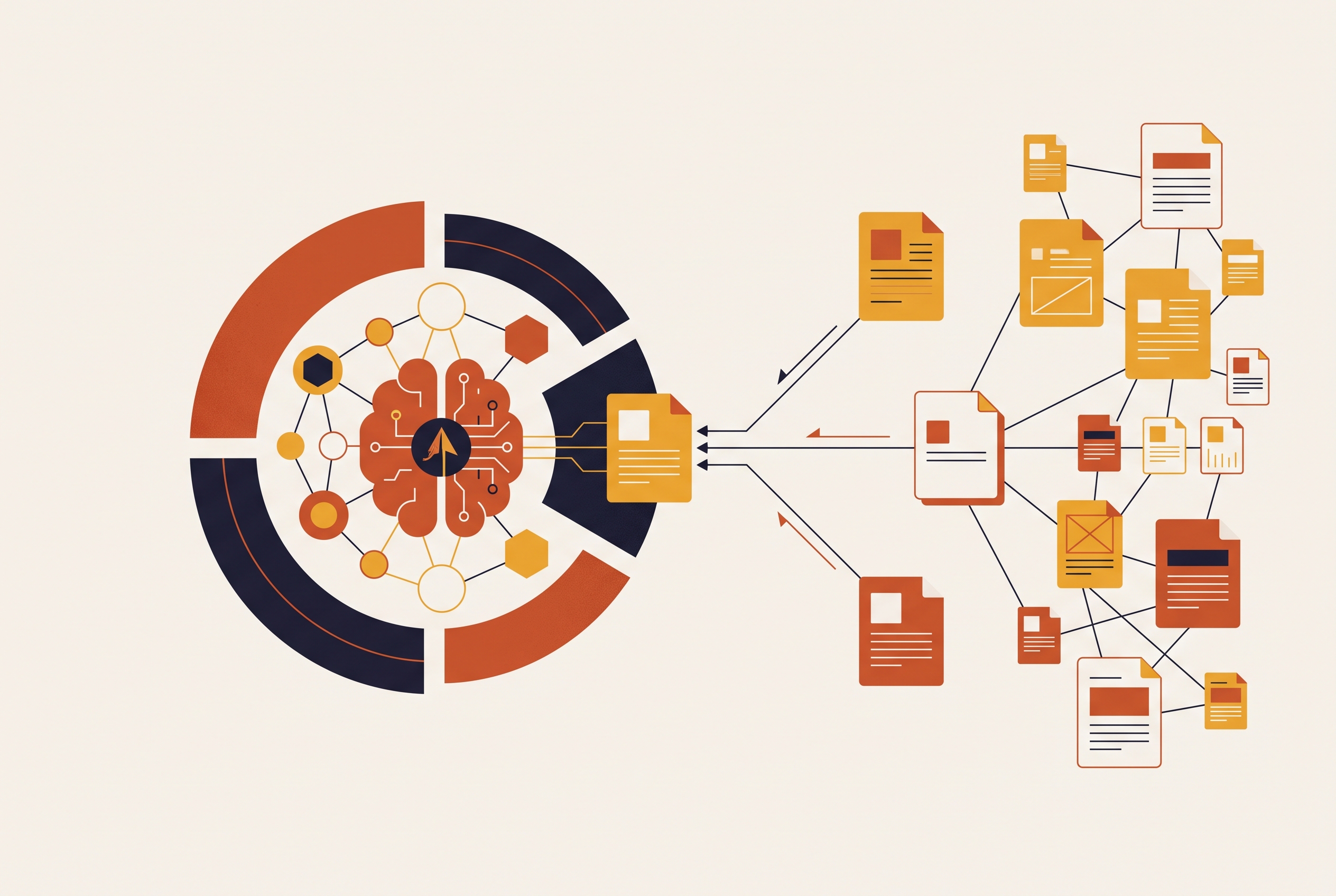
The reason ranking and citation split apart lies in the mechanism each one runs on. AI answer engines produce their responses through a retrieval-augmented generation pipeline, a process with four distinct stages: the system interprets the query, retrieves a pool of candidate content, breaks that content into chunks, scores those chunks for relevance and trust, and finally synthesizes a new response out of whatever chunks survived. Content competes at the chunk level inside this pipeline, not at the page level, and that single fact rewires almost every assumption carried over from traditional SEO. A failure at any one stage ends the citation attempt before it starts. A page that a crawler cannot access never enters the retrieval pool. If a page gets retrieved but is poorly structured, its chunks score too low to survive the trust-and-relevance filter, even when the page itself ranks well in a conventional search index.
AirOps frames AEO as pursuing three goals that map directly onto these pipeline stages: answering clearly in the format an answer engine prefers, supporting that answer with context, evidence, and credible sourcing, and signaling trust through structure, schema, and author credibility. So the first goal targets the chunking stage, the second targets the scoring stage, and the third targets synthesis itself. The chunking stage is where most content fails without any visible warning. Synthesis is generative: the model composes new text, pulling the passage that best answers the prompt from whichever chunks made it through scoring, rather than copying a ranked snippet the way a search results page would. That distinction is what turns content competition into a contest fought chunk by chunk rather than page by page, and it is the reason the three major answer engines, built on different retrieval stacks, can reach opposite conclusions about the identical page.
How different engines run their own versions of this pipeline
ChatGPT, Perplexity, and Google AI Overviews each run their own version of this retrieval architecture. A single page can be cited on one platform and ignored on another for reasons that have nothing to do with the quality of the content.
ChatGPT, operating through SearchGPT, leans heavily on Bing's index: a strong majority of SearchGPT citations match Bing's own top organic results. Ranking well on Bing is close to a prerequisite for entering ChatGPT's retrieval pool. Crawl access compounds this. A robots.txt file is no longer just a technical setting; it is a citation decision with measurable consequences.
Perplexity works on a different premise. Every query triggers a real-time web search rather than a response pulled from memory, and the platform almost always attaches clickable source links directly inside its answers, though citations can disappear in Writing mode, through third-party API clients, or in certain synthesis-heavy queries. Selection on Perplexity is narrow: of roughly ten pages the system visits per query, only three or four end up cited in the final answer. Freshness carries real weight here, and Perplexity tends to favor recently published material, but relevance and a direct, well-structured answer still outrank recency in its citation logic. A significant share of what Perplexity cites doesn't rank in Google's top results at all, yet Perplexity also has the highest overlap with Google's top 10 of any major AI platform, which makes it, somewhat counterintuitively, the platform where a non-ranking page has its clearest path to getting cited.
Google's AI Overviews and AI Mode sit closer to the traditional search index, but not as close as they first appear. AI Overviews draws from Google's existing search index through a dedicated passage-level retrieval system that runs at query time, rather than simply lifting the top organic results wholesale, which makes organic index strength a harder prerequisite here than it is on Perplexity. The overlap between AI Overview citations and organic rankings has grown over time, but it remains well below total overlap: ranking organically is necessary to get cited here, but it is not sufficient on its own. Google's AI Mode, the newer of the two surfaces, cites far more unique domains than AI Overviews does, so it seems to have a wider retrieval aperture. AirOps notes that each engine applies its own weighting to structure, freshness, and trust signals, so if you build a single distribution strategy aimed equally at all three engines, it will underperform a strategy built platform by platform.
Content signals that survive chunk-level scoring
Once a chunk clears retrieval, it still has to survive a scoring step, and that step behaves nothing like a keyword-matching algorithm. The signals that improve citation probability across all three engines are structural and credibility-based: they make a passage easier to extract cleanly and easier for a model to verify, not easier to rank through keyword density or backlink volume.
Answer-first structure shapes citation probability more directly than any other single formatting choice. A disproportionate share of AI citations draw from the early section of a page, so if you place the direct answer right beneath a question-based heading, the chunk that holds it is far more likely to get retrieved and score well. Content that buries its answer under narrative preamble fails quietly at the chunking stage: the parser extracts whatever text sits where it sits, and if the answer isn't inside the early, high-scoring chunk, it simply never reaches the response.
Expert attribution carries the heaviest individual weight of any single tactic the GEO study measured. Notably, the study's "authoritative voice" tactic, framing content as authoritative through tone alone rather than through verifiable evidence, showed no statistically significant improvement. Sounding authoritative is not a substitute for the underlying signals that make content verifiable.
Format and freshness operate as secondary but real signals layered on top of structure and attribution. Analysis of AI answers at scale found that listicles, articles, and product pages account for a majority of all citations, with listicles dominating specifically on commercial queries. Platforms vary in how much weight they give to recency, but freshness points in a positive direction across engines, and Evergreen Media's AEO guide notes that brands leading in AEO tend to update their content on a quarterly cycle.
Why vendor-authored content is structurally filtered out before synthesis
Everything in the previous section describes how to score well. Vendor-authored content runs into a different kind of wall: AI engines cross-reference brand claims against independent sources before letting them into an answer, and an owned page, by its nature, cannot supply that independent verification about itself.
The majority of AI citations draw from third-party earned sources rather than brand-owned pages, and a brand's own website contributes only a small fraction of what AI search systems actually reference, a ceiling that no amount of on-site optimization raises on its own. This is a verification architecture problem rather than a content quality problem: even a page that is well-structured, accurate, and built with every tactic from the previous section still gets deprioritized, because the source itself, the brand's own domain, cannot offer the independent confirmation that trust scoring looks for. A reasonable objection holds that good content wins regardless of where it's published, but the trust-scoring mechanism answers that directly: independence functions as its own scoring signal, separate from and in addition to the quality of the writing itself.
The "ghost citation" phenomenon makes the gap visible in practice. Keyword stuffing represents the extreme end of the same failure pattern: the GEO study found it scored negatively on position-adjusted word count, roughly 8 to 9 percent below an unoptimized baseline, because content engineered to satisfy old ranking signals actively performs worse under AI trust evaluation. The budget consequence follows directly from the mechanism: if a brand's AI visibility comes overwhelmingly from third-party sources, pouring spend into owned content inverts the actual discovery mechanism.
Third-party publication as the structural response to AI citation mechanics
Given that AI engines weight independent corroboration so heavily, placing content in third-party publications, or building editorially independent publications outright, functions as the primary channel for building citations rather than a supplementary PR tactic layered on top of a content program.
The mechanism is additive. Large language models apply something close to a majority-rule behavior when handling brand facts: if several independent third-party sources describe a brand consistently, the model adopts that description as established fact, an effect a single owned page cannot replicate regardless of its quality. Citation authority is also heavily concentrated rather than evenly spread: in most B2B verticals, a small number of publications account for the large majority of all AI citations, so a distribution strategy has to target the specific publications an answer engine already trusts in that vertical.
The case Uproer documented with a niche home improvement brand shows how this mechanism works from end to end. The brand executed a structured AEO program, FAQ content, competitor comparison blog posts, and schema improvements, and over a 90-day window from May through July, organic traffic declined 9% year over year while organic revenue rose 76%, alongside a 151% year-to-date increase in AI Overview citations. The citation gains drove the revenue outcome, not the traffic.
The "phantom publication" model represents the engineered endpoint of this same logic: an editorially independent niche trade publication, built on its own domain under its own name and voice, publishing comparison and category content that produces the independent corroboration signal at scale, inside a targeted vertical, without depending on an existing outlet choosing to cover that brand's category. In professional services specifically, third-party neutral listicles draw a large majority of citations compared with self-promotional brand listicles covering the identical topic, which confirms that the independence of the source, not merely its format, is what the scoring rewards. Phantomstory builds and runs autonomous, independent trade publications on custom domains, built so they work as legitimate niche media outlets that AI systems retrieve and cite on their own merits, so a brand gets citation presence without its content ever reading as self-promotion.
What to instrument once you understand the citation pipeline
Citation and ranking run on separate mechanisms, so if you track only traditional SEO metrics, you miss the most consequential layer of AI discovery. You need to watch citation frequency, mention rate, share of voice, and the gap between how often a domain is cited as a source and how often the brand's actual name appears inside the answer body.
AirOps's 2026 AEO guide draws this distinction explicitly: SEO metrics such as traffic, rankings, and click-through rate measure a different outcome than AEO metrics such as citation frequency, mention rate, and share of voice, and tracking only one set misses the other. A domain that earns source links without earning brand-name mentions inside answer bodies is succeeding at retrieval while failing at the parametric memory stage, and the fix for that gap sits in the breadth and consistency of third-party coverage, not in anything adjustable on the page itself. Similarweb's AEO guide frames the three sequential outcomes, retrieved, selected, and cited with the brand name attached, as the measurement structure itself: each stage can fail independently of the others, so each one needs its own dedicated signal.
Measurement timelines also diverge by platform in ways a single reporting cadence will miss. The same content program will produce a fast result on one engine and a delayed one on another, and a measurement framework that doesn't separate the two will misread both.
The home improvement brand case stands as the clearest illustration of why this measurement layer is necessary. Organic traffic fell while organic revenue rose, and AI Overview citations were the bridge connecting the two. Without a framework built to track citations specifically, that revenue gain would have been credited to nothing, or credited to the wrong cause. If a brand cannot see its own citations, it cannot optimize for them, and that single limitation is the reason AEO now stands as a discipline distinct from SEO.