
Publication Cadence and Indexing Strategy for New Phantom Domains
A launch sequence that gets new domains indexed before their freshness fades.
November 10, 2026
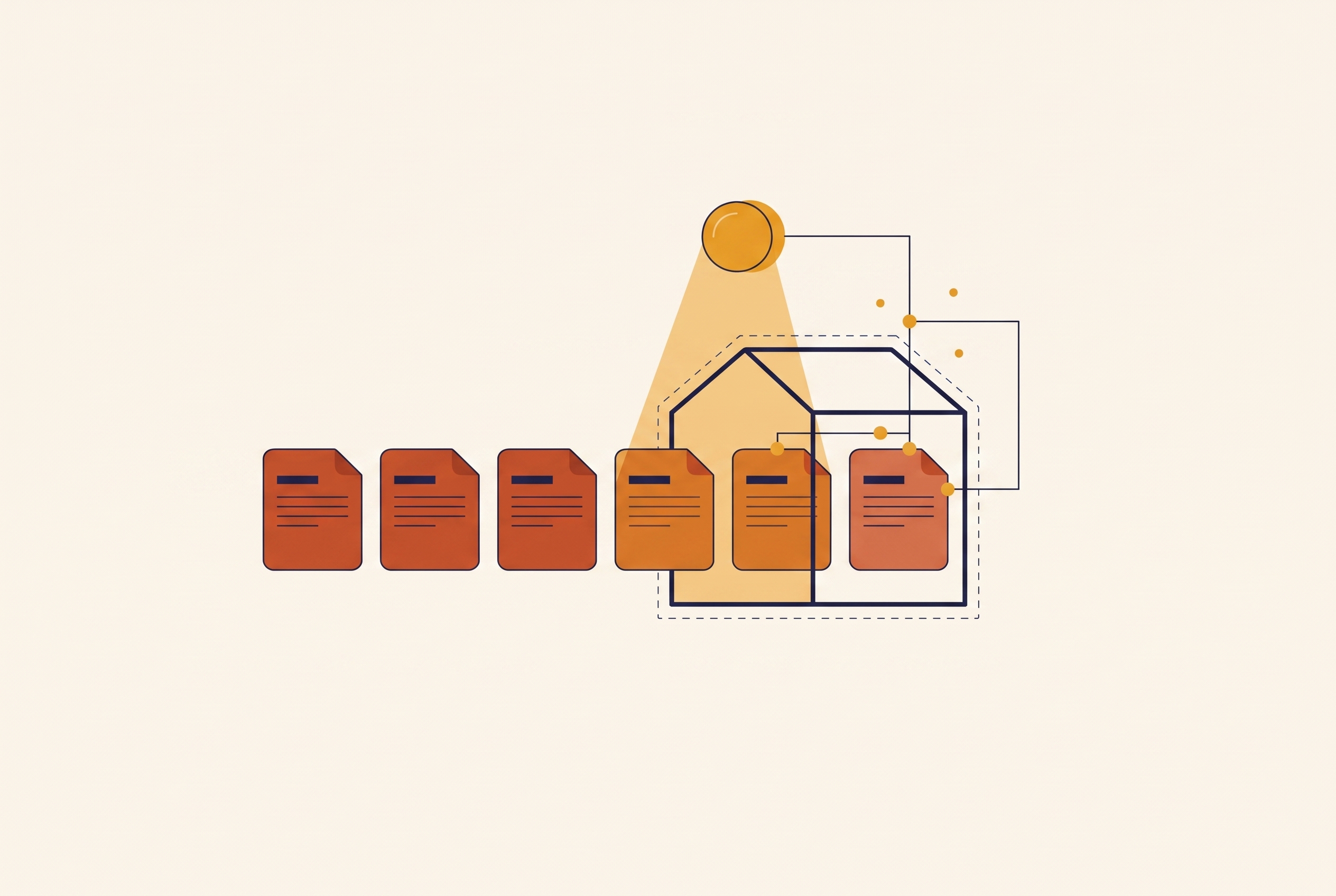
A new phantom domain needs a publication sequence. For an independent publication on its own domain, indexing must precede volume, early articles must answer retrievable sub-questions, and steady publishing must develop into a combined publishing and refresh cycle. That sequence gives fresh content a chance to enter AI citation pools before its initial advantage fades.
Why the first crawl cycle defines a phantom domain's citation ceiling
A team that publishes a large volume of posts in week one before its domain is indexed spends those articles’ freshness window without making them available for retrieval. The writing may be strong. Yet answer engines that use retrieval-augmented generation pull passages from an index, so content outside that index cannot compete for citations. Publishing more does not resolve that bottleneck.
The earliest crawl cycles also establish signals about the domain’s structure and topical focus that can be difficult to reverse later. This does not mean retrieval trust works like slowly accumulated domain authority. Selection happens per query, which gives a new publication an opportunity to enter citation pools before it could rank for competitive traditional search terms. The opportunity depends on being discoverable and useful when retrieval occurs.
That discovery process differs across engines. Google AI Overviews and AI Mode use Google’s index, Perplexity uses its own crawler, and ChatGPT draws from Bing and partner feeds. Being visible in one system does not mean a site is visible in the others. The launch sequence must therefore put crawlability and indexing signals ahead of content volume across the relevant retrieval systems.
How AI engines decide which sources enter their citation pools
Query fan-out expands a head query into related sub-questions processed in parallel. The engine then retrieves passages relevant to those branches. A page addressing only the head query covers less of that retrieval space than one containing distinct, self-contained answers to the related questions.
Retrieval alone does not secure a citation. A passage must also allow extraction, and when independent sources agree, that can give engines more confidence in its claims. Source diversity therefore limits how much one publication can contribute to an answer. Surfer’s study of AI Overviews found that most citations did not rank in the top ten for the query or its fan-outs, showing that traditional search position is not a prerequisite for selection.
Freshness introduces another distinction between engines and retrieval modes. Perplexity and Google AI Overviews reward recent material, while the parametric behavior of ChatGPT and Claude favors consistent historical presence. ChatGPT’s live retrieval through external indexes is a separate route from that historical presence. Because overlap between engines’ cited sources is low, success in one citation pool cannot stand as evidence of entry into another.
Why vendor-owned domains are structurally excluded from most AI citations
For top-of-funnel commercial queries, third-party coverage supplies much of the material from which engines build brand recommendations. A vendor domain offers the vendor’s account. That account can be relevant, but it cannot provide the same independent corroboration as an outside publication. Better writing on the vendor’s site does not remove this distinction.
The editorial formats fit that distinction closely. Listicles, comparisons, and reviews let publications weigh several options against the buyer’s question instead of building an answer around what one seller offers. A vendor publishing a comparison of itself against competitors still presents a conflict of interest. An independent trade publication has a different editorial role, provided its coverage genuinely serves the topic.
A phantom publication supplies that separate publishing structure through its own domain, masthead, and editorial voice. It creates room for the third-party formats that commercial citation pools favor. But having a separate domain does not show that a publication makes its own judgments, and common ownership should not be taken as independent corroboration. The strategic value rests on publication-level distinctness, which must be maintained through the site’s structure and the substance of its coverage.
What the technical foundation must accomplish before the first post goes live
The operational sequence begins with a submitted XML sitemap, canonical tag configuration, and robots.txt rules that allow the relevant search crawlers. These belong before the first content release. Otherwise, early publication dates can precede the domain’s entry into the indexes that make those posts available for citation. That delay consumes freshness without creating retrieval opportunities.
Crawler permissions require particular care because search retrieval and model training are not the same function. OAI-SearchBot, PerplexityBot, and Googlebot serve discovery and retrieval roles, while Google-Extended is a separate training opt-out token. Permissions must reflect those distinctions. Allowing a training crawler does not compensate for blocking a crawler used to find sources for live answers.
Structured data should also be present at launch, including FAQPage schema, Article schema with named authorship, and BreadcrumbList where appropriate to the content. These make the page’s organization available during the first crawl. Named authors should be verifiable, since an unsupported byline offers weaker corroboration than an identifiable author. Page speed and Core Web Vitals should also be part of this work before the first post goes live.
Google’s documentation says that AI Overviews has no extra technical requirements beyond standard Search fundamentals. The foundation is therefore not exotic. Its value comes from completing familiar work before publishing begins, rather than trying to repair discovery after the launch catalog is already aging.
How to sequence content architecture so early posts build toward citation readiness
Once the domain is indexable, the first articles should map to clusters of fan-out sub-questions within a narrow vertical. Each post has a specific retrieval job. Publishing isolated treatments of loosely related topics weakens the coherent topical signal that early coverage should establish. A well-written article aimed at the wrong sub-question can still miss the intended citation opportunity.
Within those posts, question-shaped headings should mirror how readers phrase their queries. A 40–60 word direct-answer block at the top of each major section makes its central answer available without requiring extraction from a long introduction. The opening words should make clear which named entities the answer concerns. These choices turn the article into passages that can stand on their own while remaining part of a complete explanation.
Evidence gives those passages a reason to be selected. Original findings, named experts, and verifiable claims offer more than reworded consensus. Surfer’s study found that most cited pages contained a list and covered more key facts than uncited pages. Lists therefore belong where they suit the answer, while depth should concentrate on the article’s particular sub-question.
Comparison, listicle, and review formats should take priority in the early calendar because they fit commercial third-party citation opportunities. Editorials and opinion pieces serve a different purpose. They should not displace the answer-focused coverage needed to make the initial catalog retrievable.
The publication frequency that creates citation velocity without triggering quality decay
The appropriate publishing rate follows the crawl cycle. New content can enter citation pools within roughly three to five business days of publication and indexing. Both conditions are necessary. A calendar based only on publication dates overlooks whether engines can retrieve the material at all.
Publishing steadily gives crawlers a reason to keep coming back, which affects how soon later posts can be found. A launch burst followed by silence breaks that continuity. The edge that burst gets from freshness can fade before the publication has enough ongoing coverage to keep earning citations. Long gaps can also leave older articles less likely to be chosen while new work waits to be found.
Engines favor verifiable expertise, corroboration, and extractable evidence, so thin articles cannot substitute for specific answers. Templated workflows and AI-assisted drafting can support throughput within a governed editorial process. Their purpose is to preserve depth at a workable pace.
The practical rate is therefore the fastest consistent schedule that preserves those qualities and keeps pace with indexing. A calendar of specific buyer sub-questions provides the unit of work. Broad topic buckets make it easier to publish more, but give less assurance that each new post adds answers to the citation pool.
How to build a refresh and update cadence that prevents citation decay on existing posts
As the catalog grows, publication frequency becomes only one part of maintaining visibility. Pages get older even when they are still well structured. Perplexity places particular weight on freshness, while Google AI Overviews layers freshness onto traditional organic ranking signals and shows a weaker freshness bias. The maintenance schedule must account for those differences.
A refresh need not become a full rewrite. Updating statistics, replacing outdated named sources, and adding a section for a newly relevant sub-question can restore the page’s usefulness. Re-submitting the URL for indexing then supports discovery of the changes. The work should bring the evidence and answer up to date as well as the date itself.
Posts that already earn citations deserve priority because they have demonstrated a fit with retrieval demand. Protecting that position can cost less than producing a new article that must enter the pool from zero. A growing catalog increases this opportunity. Without maintenance, moving sources and aging facts progressively weaken the evidence that originally made its passages citable.
Refreshes should therefore be on the same calendar as new articles. The allocation can shift toward maintenance as the back catalog expands, especially in fast-moving fields. This also serves the distinction between fresh retrieval and historical presence. An established page kept current can support both, rather than forcing the publication to choose between recent output and a durable body of work.
Why a single phantom domain has a citation ceiling and what a fleet solves
Engines build answers from a mix of sources instead of turning to the same publisher again and again. Query fan-out creates more retrieval opportunities, but those opportunities do not all become available to the same domain. No matter how much one catalog grows, it cannot offer the source diversity of several separate publications.
A fleet extends coverage across publications, verticals, and engine-specific retrieval patterns. Some publications can emphasize Perplexity’s crawler, while others focus on Google’s index or Bing-sourced ChatGPT retrieval. Each still needs its own indexing foundation and content sequence.
Corroboration can also help when separate publications back the same claim with evidence that bears on it. Repeated assertions alone are not the equivalent of independent support. A well-built fleet needs original content and publication-specific editorial treatment.
Phantomstory’s model deploys standalone autonomous publications on custom domains, each with its own name, masthead, editorial voice, and original content. Deployment speed can extend coverage across multiple verticals, but the value of each publication still depends on its distinct contribution. Separate identities make room to publish more, but do not ensure that engines will treat every mention as independent corroboration.
Measuring whether a phantom domain has entered the citation window
Before interpreting a lack of citations, teams should establish eligibility by checking whether the domain is indexed by Google and Bing and discoverable by the relevant proprietary crawlers. Zero citations in the first two weeks may reflect an indexing failure. That diagnosis calls for technical work.
Once eligibility is established, the next layers are extraction rate, citation share, and assisted conversion. Extraction rate asks whether passages make it into AI answers, while citation share tracks how many of the answers to target queries cite the publication. Assisted conversion links that exposure to what people later do with the brand.
Weekly prompt audits during the early months should run target queries through ChatGPT, Perplexity, Google AI Mode, and Gemini. When citations appear, passage analysis should show whether engines chose the answer blocks and direct-answer openings they were meant to choose. That comparison tests the architecture directly. Citations without assisted conversions may instead show that the coverage is being found for the wrong queries.
Results also require engine-specific interpretation. Fresh retrieval can respond sooner than parametric historical presence, so the earliest weeks are not a fair test of every route to visibility. A successful first few months has a concrete pattern, with the domain indexed within week one, first citations appearing within two to three weeks, and citation share growing as the back catalog deepens and refresh cycles begin. These are launch targets to measure against.