
Structured Content Formats That AI Engines Prefer
AI answer engines reward extractable facts over polished prose.
October 15, 2026
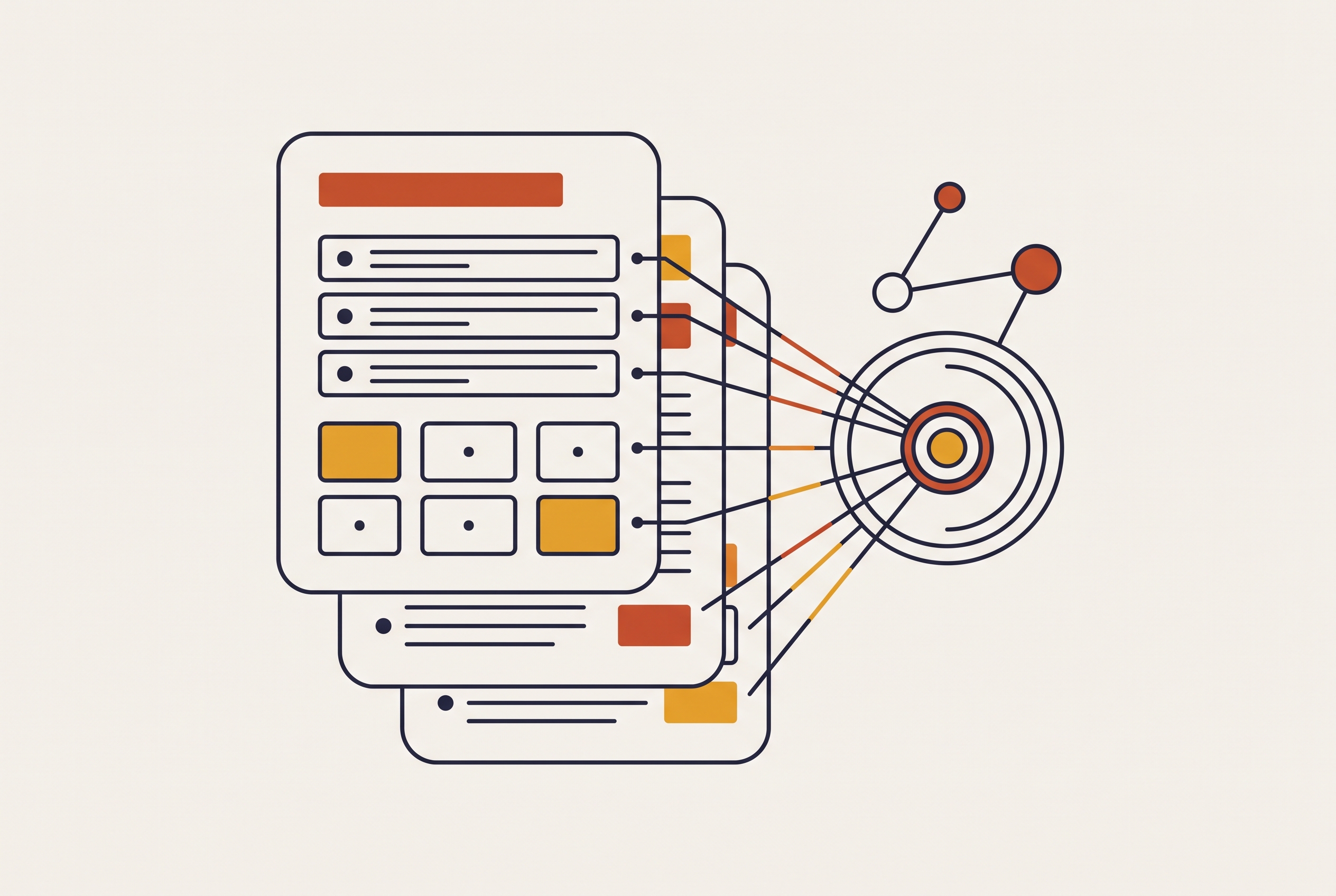
AI answer engines don't reward polish or volume. They reward content architectures that let them extract, verify, and safely quote individual claims. The practical core of answer engine optimization is understanding which structural signals trigger citation, and building pages that carry those signals from the start.
How AI answer engines decide what to quote
The selection process runs through a four-stage pipeline: query interpretation, retrieval, relevance scoring, and answer synthesis. Each stage optimizes for something different, and a page that clears one stage can still fail the next. During query interpretation, the engine rewrites the user's question into several narrower sub-queries, called fan-out queries, and runs separate searches for each. A page must rank for those derived sub-queries, not just the original question. During retrieval, candidate pages are scored on relevance, authority, recency, and structural quality. Structural quality is the one variable a content team can change fastest, and it's the variable most teams leave unexamined.
The citation stage is where the real filtering happens. The engine extracts specific facts and attributes them to a source, and content that buries its claims inside long paragraphs gives the engine nothing to anchor a citation to. Being findable decides the retrieval step. Being quotable decides the citation step. Most content teams optimize hard for the first and ignore the second entirely, which is why pages that rank well in traditional search can remain invisible in AI answers.
Why "checkable" content is structurally safer for an AI to quote
AI engines treat a claim as low-risk to repeat when it is specific, attributed, and verifiable. A confident but unanchored assertion is a liability the engine routes around, because it has no way to confirm the claim without exposing itself to error. A page that carries a named source, a specific date, and a discrete fact gives the engine something it can check against other sources before repeating the claim. That checkability is what the engine's trust heuristic is actually measuring. Confident prose with nothing to verify is not rewarded, however polished it is.
Answer engine optimization sets three goals for a page: answer the question clearly in the format engines prefer, support the answer with context and credible sourcing, and signal trust through content structure, schema, and author credibility. All three gates must pass before a citation fires. This is why AEO is an architectural problem, not a prose problem. The structural signals that make content checkable cannot be added after the fact by editing tone or improving headings alone. A content team that treats citation as a writing quality issue will underperform a team that treats it as an information design issue, every time.
The six structural signals that make a page citable
Six structural choices determine whether a page's content gets extracted and cited. They work as an interconnected architecture, not a checklist. A page with bullet formatting but no sourced claims, or schema markup with no answer-first opening, still underperforms.
The first signal is the answer-first opening, known as BLUF structure: bottom line up front. Answer engines favor pages that lead with a clear response and back it up with evidence. The direct answer must appear early, before any context or preamble. Burying the answer under scene-setting paragraphs means the engine's passage-extraction logic may never reach it.
The second signal is extractable chunks with semantic headings. Logical structure with headings and semantic chunking is one of the explicit signals AI platforms use when selecting sources. Each section should be independently answerable. A reader, or an engine, arriving at that section mid-page should be able to extract the claim without needing the surrounding context. This is the core structural difference between SEO and AEO: SEO optimizes at the page level, while AEO optimizes at the fact and passage level.
The third signal is lists and bullet-point formatting. A large share of AI Overview responses use lists or bullets, and formatted content gives the engine a ready-made output structure it can reproduce verbatim or near-verbatim. Prose that contains list-like information but presents it in paragraph form forces the engine to do extra parsing work. Lists remove that friction.
The fourth signal is explicit entity definitions. AEO adds explicit entity definitions as a requirement SEO does not. Naming and defining the people, organizations, products, and concepts a page covers helps engines resolve what the page is about and connect it to related queries. An entity defined precisely in the text is easier to anchor a citation to than one that is implied or assumed.
The fifth signal is statistics and data points with cited sources. These are among the highest-priority signals for source selection, because a specific figure tied to a named origin is both checkable and quotable. Original data or unique research dramatically increases citation likelihood compared to purely qualitative content.
The sixth signal is schema markup, specifically FAQPage, HowTo, and Article types. Schema markup signals answer format to AI extraction systems, and FAQPage schema for question-answer pairs is the most directly applicable type for AEO. But the role of schema carries a critical limit. Schema makes content easier for machines to parse, but its direct effect on AI citations is not proven. It is a supporting signal, not a shortcut. Schema that does not reflect visible, structured content on the page delivers no benefit. Practitioners routinely overclaim schema's role, and the evidence simply doesn't support those claims.
Content freshness as a structural signal, not just a hygiene task
Recency functions as a proxy for reliability in AI engines. Content that isn't regularly updated loses citation eligibility regardless of how well it was structured at launch. Content cited by AI assistants is measurably fresher than content ranking in traditional organic results, and the gap is not incidental. It reflects engines actively preferring recently updated sources as lower-risk. Perplexity in particular rewards primary sources and recently refreshed content at a substantially higher rate than stale content. Publishing a well-structured page and leaving it static is a half-measure. The freshness signal decays, and citation eligibility decays with it.
Brands leading in AEO treat content updates as an ongoing production commitment, not a one-time publishing event. Quarterly refresh cycles are the documented practice among top-cited sources. The freshness signal only reaches engines that can actually crawl the page. Blocking AI search and retrieval crawlers in robots.txt can sharply reduce citation eligibility, though studies show citation rates often persist due to prior indexing, extraction from search engine results pages, and bot non-compliance. Blocking training-only crawlers has little to no effect on citation eligibility. A documented case makes the stakes concrete: a major retailer's AI citation share dropped sharply after it blocked AI crawlers, while a competitor that kept access gained ground and overtook it.
How citation behavior differs across ChatGPT, Perplexity, Gemini, and Google AI Overviews
Each major AI engine applies its own weighting to structure, freshness, and trust signals. A single-engine optimization strategy leaves meaningful citation share on the table, and the differences are not subtle. ChatGPT operates like an academic paper. It surfaces brand names in only a minority of answers and cites sources at a low rate, with a zero-citation rate exceeding 40% in multiple studies. A citation is likely but a name-mention in the answer body is not. ChatGPT concentrates heavily on Wikipedia, Reddit, and recognizable authority domains like Forbes and Business Insider, leaning on strong domain authority as a citation-confidence proxy. It averages the fewest citations per answer of the major platforms, so each citation slot is more competitive.
Perplexity is built around source citations. Every answer links directly to the pages it pulled from, so structured, extractable content has the clearest payoff here. Perplexity runs its own crawler, PerplexityBot, rather than relying on a third-party index, which means crawl access and freshness are independently important signals. It cites brands at a substantially higher rate than ChatGPT, and the gap between the two platforms in brand citation rate is dramatic.
Gemini does the inverse of ChatGPT. It mentions brands in the answer body at a lower rate than ChatGPT and also links back to sources far less often. Brand name visibility is high, but URL attribution is low. Gemini is more conversational in structure, weaving brand names into answers rather than attaching footnote citations. Optimizing for Gemini is partly a brand-entity recognition problem, not just a structural one. It averages more citations per answer than ChatGPT, making it a more distributed surface.
Google AI Overviews sit within a broader ecosystem that spans People Also Ask boxes, featured snippets, and AI chat platforms. Google's surfaces reward content that is already indexed and authoritative in traditional search, making SEO a prerequisite rather than a substitute. Only a minority of AI Overview citations come from pages in Google's organic top ten. Ranking first does not guarantee inclusion, and pages far outside the top ten regularly appear in AI Overviews. Google AI Mode, a separate fully conversational search experience, applies similar weighting but operates as a distinct surface.
The cross-platform implication is clear. ChatGPT rewards extractable content, Gemini rewards brand recognition embedded in parametric knowledge, and Google AI Mode rewards something between the two. A strategy that optimizes for one engine at the expense of the others is structurally incomplete.
Why owned content is a verification layer, not a discovery engine
A large majority of AI citations originate from third-party sources, which means a brand's own website, however well-structured, contributes only marginally to initial brand discovery in AI answers. Multiple independent research efforts measuring AI citation sourcing have converged on the same finding: the overwhelming majority of citations come from external, earned sources, not from the brand's own domain. The mechanism is not arbitrary algorithmic preference. It is trust architecture built into how models were trained. A brand making positive claims about itself is recognized as self-interested. A third-party source making positive claims about a brand is recognized as a credible signal. Owned content's legitimate role is verification. After a third-party source names the brand, the engine checks the brand's own site to confirm that the claim holds. Owned content handles the verification step, not the discovery step.
A documented case makes the failure mode concrete. A brand applied the textbook AEO fix: deepened pillar content, improved E-E-A-T signals, added structured data. It still lost visibility in AI answers, because its content existed almost entirely on its own domain with minimal third-party publication. The problem was distribution architecture, not content quality. AEO requires being retrieved, being trusted enough to be selected as a primary source, and being cited with the brand name. A brand that misses the third-party distribution step fails the second gate before the citation step is ever reached.
What third-party content gets cited — and what gets ignored
A brand mention in external coverage is not automatically a citation opportunity. The engine needs a specific, attributable, structured claim, not a passing reference in a trend roundup. A large majority of brand mentions in AI-cited commercial answers come from external domains, but the form those mentions take is decisive. A large share of third-party mentions that convert to citations originate from listicles, comparison pages, and review roundups, though long-form articles are also a major citation source, particularly for informational queries.
Position within the external document matters as much as placement on the external domain. Most mentioned brands appear within the first three positions on those pages. An article in a recognized outlet that mentions the brand in passing, buried in a trend roundup with no direct quote and no data attribution, gives the engine nothing to anchor a citation to. A mention is not a citation opportunity. A sourced and structured claim is.
Citation share concentrates in just a small number of publications per industry. A handful of top domains capture 68% of all consolidated AI citation share. The sixth, seventh, and eighth positions in any vertical are unowned and ownable within 9 to 12 months by any publisher that structures content for retrieval. In technology, structured product evaluations from outlets like PCMag and TechRadar out-cite editorial features from prestige outlets. Format and structure predict citation. Prestige alone does not.
How independent trade publications become AI-preferred citation sources
An autonomous trade publication, with its own domain, editorial identity, and structured content, is categorically more citable than a brand blog or a passing mention in someone else's roundup. It satisfies the trust, independence, and format signals engines require simultaneously. AI engines treat source independence as a trust signal. A publication that exists to cover a vertical, with its own masthead and editorial voice, reads as a credible third party in the same way a trained model learned to treat trade press during training. A standalone domain reinforces this signal. Content on a dedicated niche publication domain does not carry the vendor-attribution flag that content on a brand's own domain carries.
Structural independence must be matched with structural formatting. If a trade publication publishes long, unstructured editorial features, it fails the extractability test even if its independence signal is strong. The publication needs editorial credibility combined with AEO-ready architecture: answer-first sections, explicit entity definitions, sourced claims, and schema markup. Topic coverage matters more than single pages. A publication that owns a topic space across multiple structured articles gives engines repeated opportunities to cite it across different fan-out sub-queries from the same buyer question.
The content quality constraint applies throughout. AI engines reward depth, specificity, and genuine usefulness. A publication that produces volume without editorial standards is a liability, not an asset. What engines surface is content that reads as independently authoritative and is structured for extraction.
Phantomstory operationalizes this model. Each deployment is a standalone, autonomous trade publication on a custom domain, with its own name, masthead, editorial voice, and original illustrations. The architecture is purpose-built to satisfy both the independence signal and the structural formatting requirements that trigger AI citation, and it deploys fast enough to begin building citation eligibility before competitors claim the open positions in a vertical. The strategic logic is straightforward: owning a fleet of niche publications means a brand's point of view is present in the sources AI engines read and cite, without the vendor-attribution discount that makes owned content structurally invisible at the discovery stage.